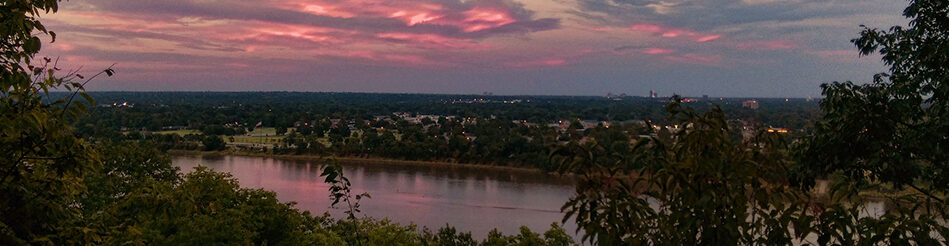
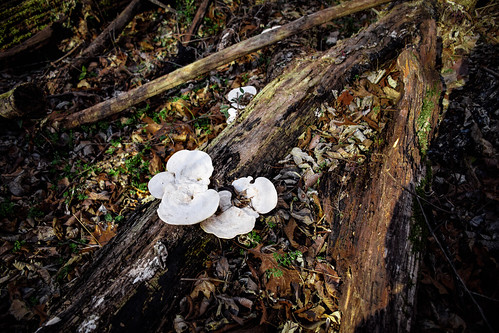
The weather is warming up fast these days. Just ten days ago we had snow everywhere, now it is almost all gone and we have balmy temps. These pics are from a hike about a week ago around Tulsa’s Lafortune Park on their 3 mile path.
My favorite tree at Lafortune Park. It makes for a great photo all four season. I love the reflections as well. We have a little ice in this photo.
And a little bit more ice near the playgrounds.
And at the duck pond.
And a decent sunrise from our backyard. Our little terrier Sadie gets me up every morning for the sunrise.
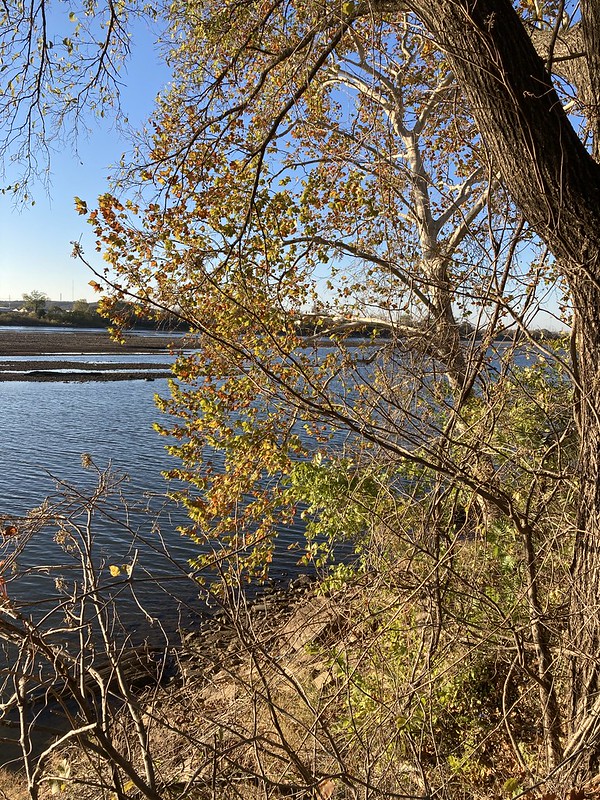
Late Autumn always puts me in a mood. Not a bad mood, just an introspective mood. P. These photos kind of match my mood. Not necessarily sad.
Bixby, Oklahoma’s Washington Irving Park. It’s a very old park with a lot of big trees.
Tulsa’s Mohawk Park, a sprawling 2800 acres. One of the largest municipal parks in the USA and very underdeveloped. Lots of land for roaming around. The day I shot this, I was attending a Geocaching Black Friday event. Lots of people, lots of geocaches to find and chat with friends.
https://flic.kr/p/2rJMUFW
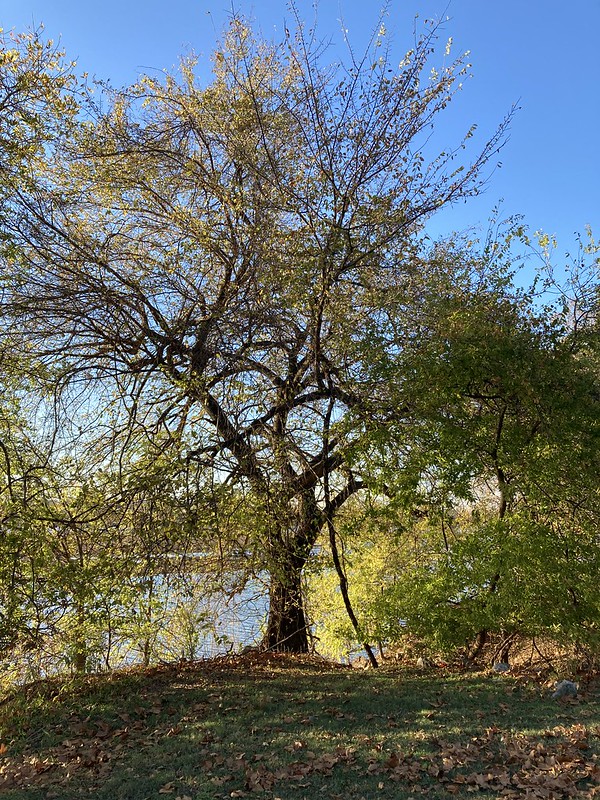
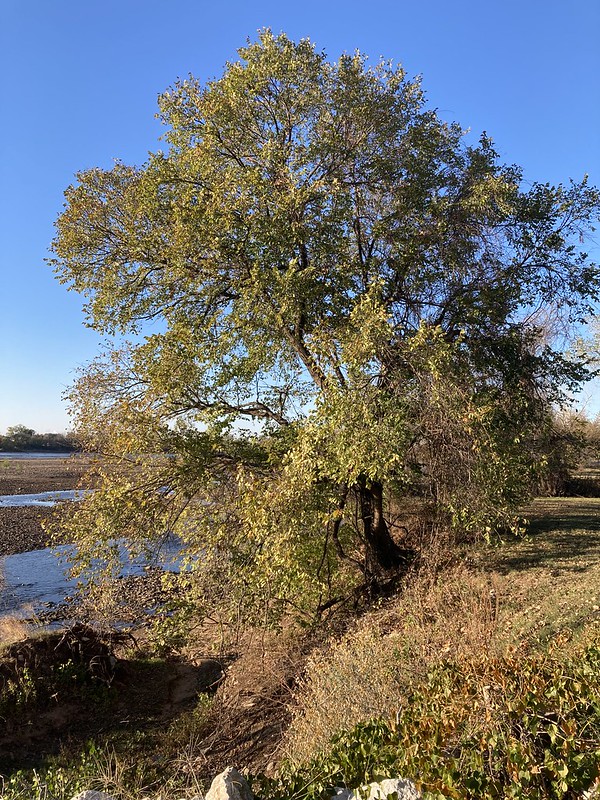
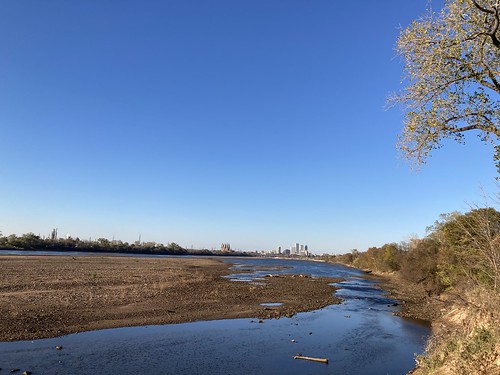
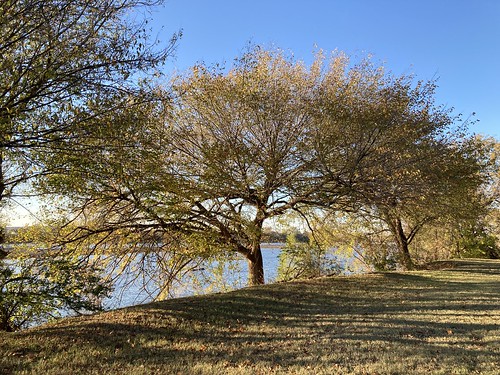
Tulsa’s RiverParks Trails. I found this tree and an instagram friend suggested naming it “The Tree of Life.” Works for me. Tulsans love the RiverParks, miles and miles of trails, playgrounds, the Gathering Place, and Turkey Mountain. Plus it links to other trails both east and west going to other trails in other suburbs.
Saturday I took a short walk on a bicycle path to look for a geocache.
Across this funky enclosed bridge across Mooser Creek.
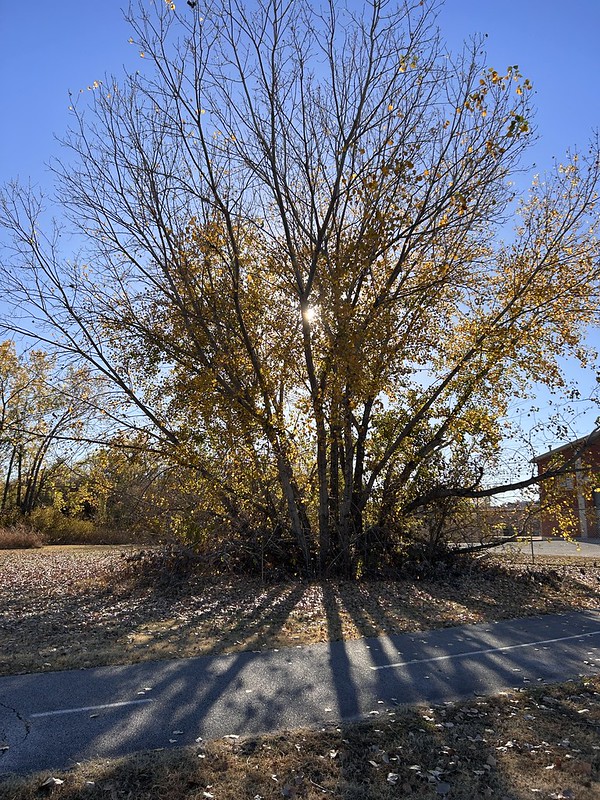
Next to this tree bunch casting some cool afternoon shadows.
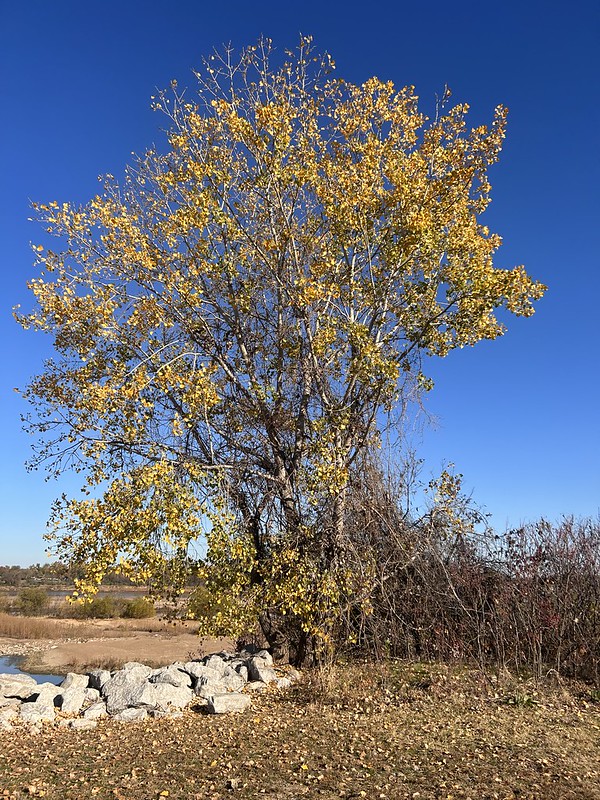
The cache is somewhere in the rocks to the left of the tree. Ididn’t find the cache. It’s about the third time I’ve looked. Everybody else is finding it pretty easily. Oh well, I had a nice walk.
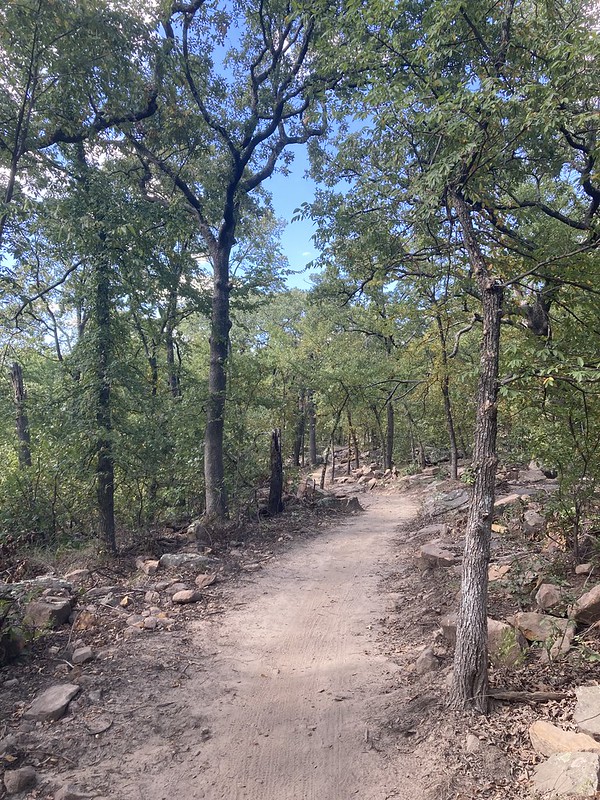
I was up on Turkey Mountain Tuesday afternoon, watering the Monarch Way Station. A nursery had donated some plants to us on Saturday and we planted and watered them that day. It’s been scorching since so I watered them again. Still hot. Fortunately I have pretty good place to watch the watering, and the goings on in the main parking lot. Took me about an hour to do and I decided to go on a short hike.
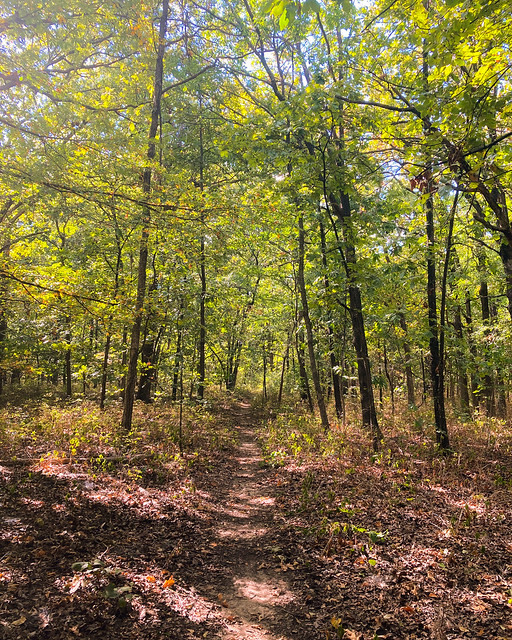
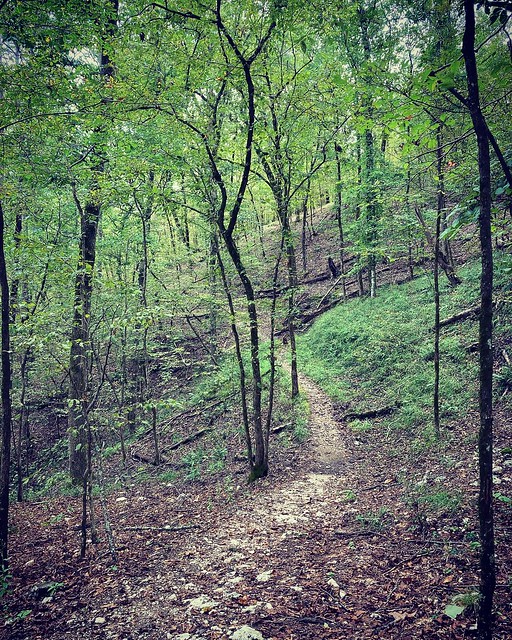
I drove up to the upper parking lot and took off to what some call the “back country” to the northwest. Not near as many people that way. I saw two mountain bikers and another hiker during my trek. I used a combination of new trails including the above, and…
the older trails which still hold most of the mystery of Turkey Mountain to me. I can feel the history on Turkey Mountain. It’s had farmers, cattlemen, oilfield roughnecks and drillers, moonshining, and up until the cartels put them out of business, meth labs. I still think that there is a lot of monkey business goes on.
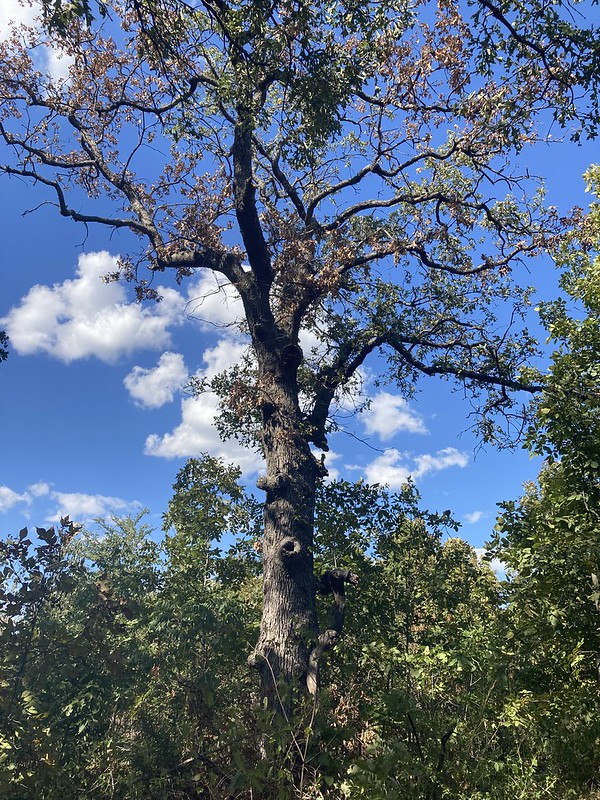
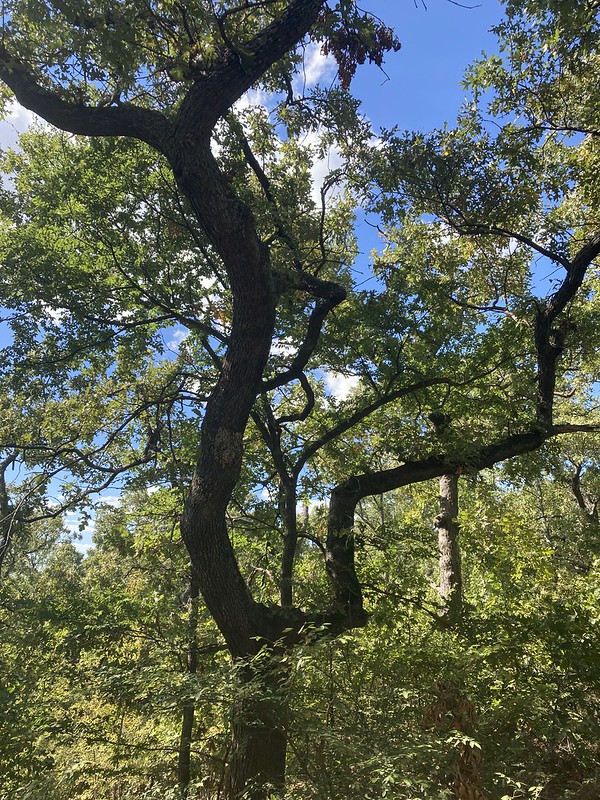
I was checking out the trees, many of them are wild and twisted. The competitive forces of nature at work.
Nature is just awesome. Below is the route I took.
And now a bonus section courtesy of NASA. It is the clearest view of Neptune us earthlings have seen since the Voyager 2 satellite moseyed by in 1989. This was shot with the James Webb Space Telescope.
Photo courtesy of NASA, ESA, CSA, STSc under a Creative Commons License. Click on photo to get the details.
It is shot in near infrared light so it is not as blue as previous images. You can see the rings (Neptune has rings? Now I know). And 14 moons!!!
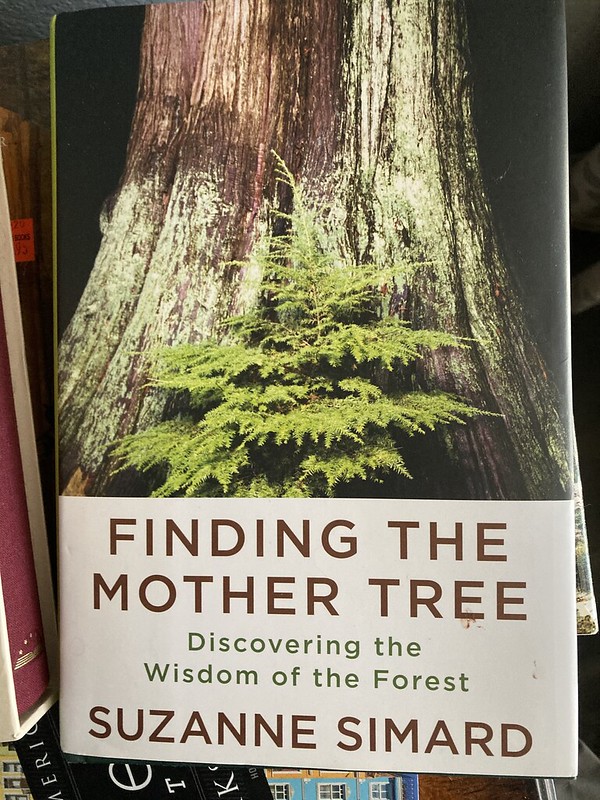
This is a book about trees and somewhat of a memoir of Suzanne Simard and it just blew me away. It starts with her as a student intern working for a logging company in Canada and she is trying to figure out why Fir tree seedlings planted in a former clear cut do not thrive as expected. Why not, they have no competition from other trees, lots of sunshine and water. What is missing? So she starts trying to find out. She designs experiments with help from people from her work and over time she finds out that the fir trees need birch trees. It turns out that to professional foresters birch trees are weeds. They rob the valuable firs of sunshine, nutrients, and water.
Simard eventually rediscovers that birch trees and fir trees are linked by a fungus, a mycorrhizal fungus, that links the roots of birch trees and fir trees and this fungus facilitates the transfer of water, carbon, and other nutrients between the trees based on the needs of the trees. A great part of the book is Simard’s description of the experiments she ran to prove all this. Experiments in the woods are hard. Lots of digging to install barriers to prevent this fungus from connecting certain trees. Lots of exposure to radioactive gases as some of the trees are fogged with isotopes of carbon to help with tracing. Exposure to powerful herbicides when vegetation needs to be killed as part of the experiment. And then the dreary following up measuring how the various trees are growing and then running the data analysis.
And then presenting the data at conferences and trying to get published and getting the cold shoulder and outright hostility from the older, mainly male, foresters who reject her findings outright. It’s a story of perseverance as she slowly gets her message out and government agencies and logging companies start using her recommendation to make replanted forests grow faster and healthier, not just for the trees but for the whole ecosystem.
She writes about birches and firs but the forests are interconnected by all sorts of fungi between all sorts of species. She also writes about mother trees who somehow recognize their offspring and provide these “sons and daughters” extra nutrition and help to survive. None of this is speculation, she has proof that it occurs.
At the end she talks about salmon, grizzly bears, trees in the pacific coast of British Columbia. A major source of nitrogen it turns out in the trees on the coast, extending far inland, is from salmon. (How do they know that, because the isotope ratio for nitrogen in salmon is different from the native ratios in the soil). During the spawning season grizzly bears eat thousands of salmon and leave the carcasses to decompose. The evidence suggests that maybe the fungus network may be able to transmit the salmon nitrogen hundreds of miles underground. No proof yet, but stay tuned.
What makes the book special is not just the science but Simard talks about her own life and struggles with marriage, children, career, and health. She’s kind of my hero right now. Talk about somebody who has a passion for many things and does her best to carry forward.
Tell you what though, I am looking at trees and fungus with whole new eyes. As I hike my favorite trails here in Oklahoma I am looking at the trees and fungus with new eyes. Simard focuses her story the mycorrhizal fungus but there are literally thousands of other fungi out there that form networks between trees and other trees, and shrubs, and grass and every other type of plant you can think of sending nutrients here there and everywhere depending on season and need. It’s all kind of mind boggling.
I visited the Gilcrease Museum here in Tulsa earlier this week. They have a lot of nice exhibits going on but what really struck my eye was a great big cottonwood tree right outside a giant window that was shimmering in the wind so I made a brief video of it and posted it on social media.
Cottonwood in South Dakota
A cousin from South Dakota told me that she thought the Lakota Tribe called the cottonwood, the Tree of Talking Leaves. I have googled a lot and have not been able to confirm that that is true but have found a lot of references that the tribe holds the tree sacred and represents a magical time of hope, healing, and transformation.
Cottonwoods in Tulsa
I have always liked cottonwood trees but never much thought about them until my cousin’s remark and then I thought, you know I have lived all over the west, Oklahoma, Texas, Arizona, Utah, and New Mexico and they all have cottonwood trees. I think they may be a symbol of the west, where the west includes the midwest. I just love seeing and hearing their leaves when the wind is blowing.
Late in life, the Cottonwood is now the Talking Leaves Tree to me as well.